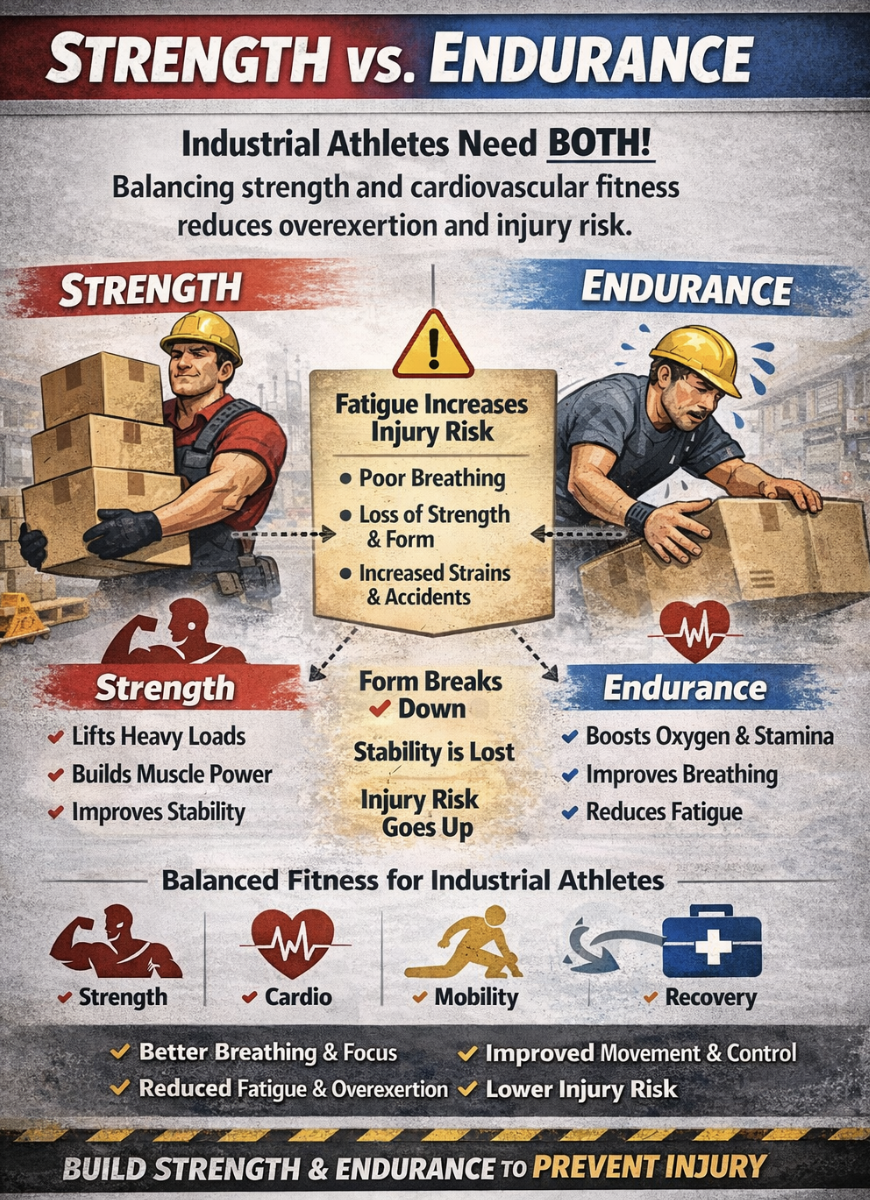
Strength vs Endurance: Why Industrial Athletes Need Both to Reduce Injury Risk
In physically demanding workplaces, strength is often seen as the primary requirement for performing the job. Employees must lift materials, push carts, pull loads, and perform repetitive tasks throughout their shift. While strength is certainly important, it is only one piece of the equation.
To perform these tasks safely over the course of an entire workday, the body also relies heavily on cardiovascular endurance.
Understanding the relationship between strength and endurance can help reduce fatigue, improve movement quality, and ultimately lower the risk of musculoskeletal injuries.
The Physiology of Work Capacity
Every time a worker lifts a box, carries a load, or pushes equipment, the muscles require energy. That energy depends on oxygen delivery through the cardiovascular system.
When the body begins to work harder:
The heart pumps faster to deliver oxygen-rich blood to the muscles.
The lungs increase breathing rate to supply more oxygen.
Muscles use that oxygen to continue producing force.
This process is often described through VO₂ capacity, which represents the body's ability to deliver and utilize oxygen during physical activity.
Workers with higher endurance capacity can sustain activity longer before fatigue begins to compromise movement quality.
What Happens When Endurance is Low
When endurance is insufficient for the demands of the task, fatigue develops more quickly. As fatigue increases, several changes occur:
Breathing becomes labored
Muscle coordination decreases
Posture begins to collapse
Joint stability declines
Movement patterns become less controlled
When this happens, the body often compensates by shifting loads into less stable positions, such as excessive spinal flexion or shoulder elevation.
These compensations significantly increase the likelihood of overexertion injuries, strains, and cumulative trauma disorders.
Strength Alone Is Not Enough
Many people focus exclusively on strength training. While strength improves the ability to move heavy objects, the ability to repeat those movements safely over time depends on endurance.
Think of it this way:
Strength determines how much force you can produce.
Endurance determines how long you can maintain safe movement under load.
A worker may be able to lift a heavy object once with excellent form, but if they become out of breath and fatigued halfway through the shift, the body begins to lose the ability to maintain proper mechanics.
Why Breathing Matters
Breathing is closely tied to core stability and movement control. When someone becomes extremely out of breath, their body shifts into a stress response. This often leads to:
Reduced trunk stability
Poor lifting mechanics
Increased panic or urgency during tasks
Reduced control over movement
This is similar to the instinctive response people feel when they cannot breathe underwater — the body prioritizes air over everything else. In the workplace, this physiological response can lead to rushed movements or abandoning safe posture.
Building Balanced Industrial Fitness
For industrial athletes, a balanced approach to conditioning is key. This includes developing:
Strength
Ability to move loads safely
Muscle stability for joints and posture
Cardiovascular Endurance
Sustaining physical work throughout the shift
Delivering oxygen efficiently to working muscles
Mobility
Allowing joints to move through safe ranges
Reducing compensation patterns
Recovery
Allowing muscles to restore energy and maintain performance
Practical Strategies for Improving Endurance
Improving endurance does not require extreme workouts. Small habits can make a meaningful difference:
Brisk walking or light cardio activity several times per week
Performing pre-shift dynamic warm-ups
Taking short movement breaks during long periods of work
Maintaining proper hydration
Practicing controlled breathing during lifting tasks
These simple practices help increase overall work capacity and reduce fatigue during physically demanding tasks.
The ActionOnsite Approach
At ActionOnsite, we support industrial athletes by focusing on movement efficiency, conditioning, and proactive injury prevention.
By educating workers on the importance of both strength and endurance, we help teams build the physical resilience needed to perform demanding tasks safely and consistently.
Because the goal of injury prevention is not just strength.
It’s sustainable performance throughout the entire shift.